
How the Adidas TRIONDA Ball Could Reshape Soccer
The most important piece of equipment at the 2026 FIFA World Cup may no longer be just a “ball.”
Embedded with sensors and connected to artificial intelligence systems, FIFA’s official 2026 match ball, the TRIONDA, sits at the center of a broader effort to blend human judgment with machine-generated data.
“It’s a very sophisticated system that glues together multiple computer vision techniques,” said Chenliang Xu, an associate professor of computer science at the University of Rochester and expert in computer vision, to the university’s News Center. “You have calibrated cameras, real-time vision models to detect the ball, players, and their poses, as well as a decision layer to identify when some sort of intervention needs to happen.”
Tournament organizers say the technology will improve accuracy, officiating decisions and enhance broadcasts.
At the same time, the World Cup is becoming a global test case in the debate over how artificial intelligence should be used in sports.
For more than a century, soccer’s most important piece of equipment consisted largely of leather, synthetic materials and air. This year, the ball is also a data platform.
The Adidas TRIONDA match ball contains an inertial measurement unit sensor that records movement data 500 times per second and transmits information to FIFA’s officiating systems.
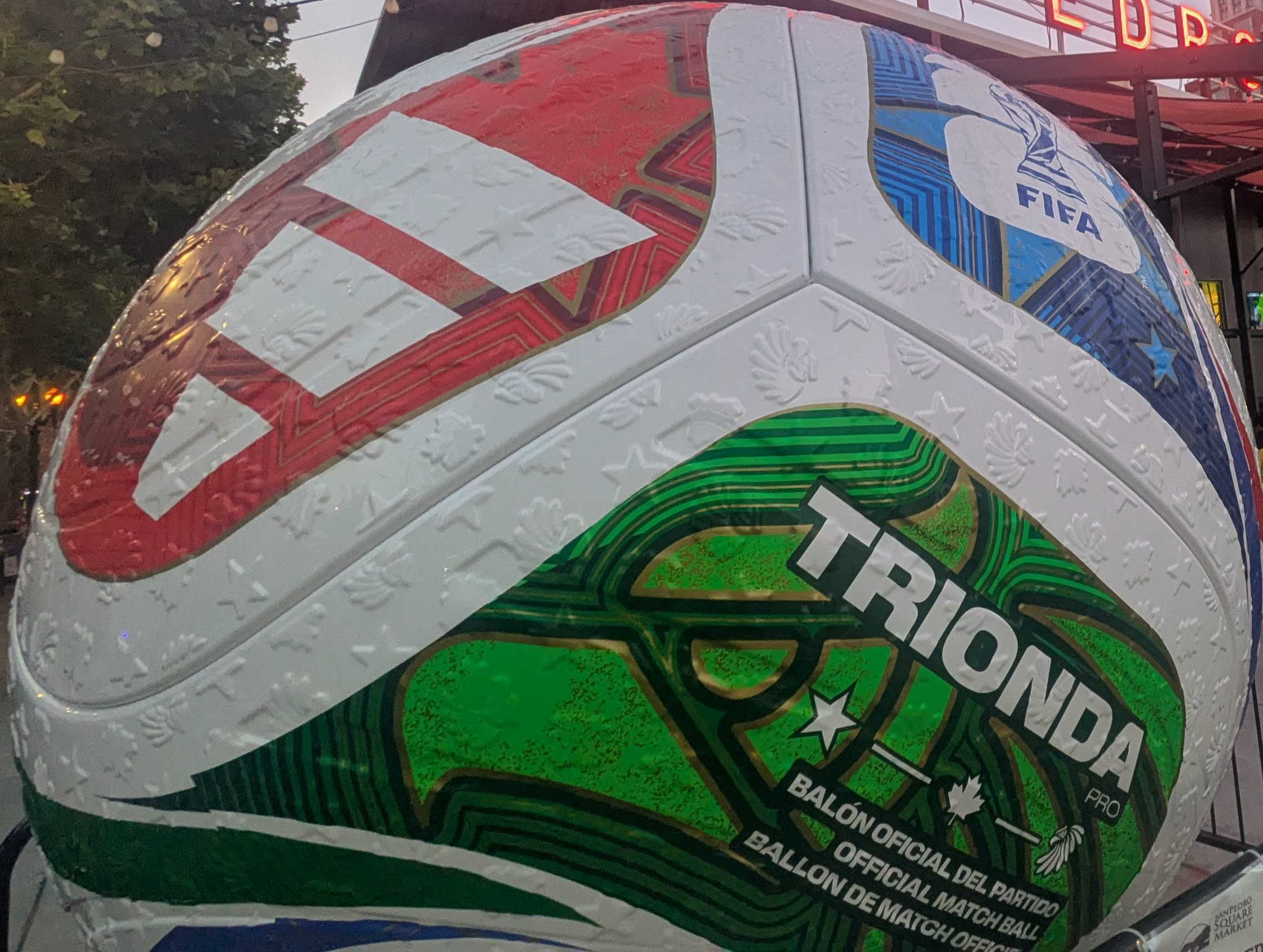
The sensor allows officials to pinpoint the exact moment a player touches the ball. Combined with optical tracking cameras, the data helps evaluate close offside calls and other disputed plays.
The ball is only one layer of a larger digital infrastructure.
FIFA’s semi-automated offside system combines camera tracking, ball-sensor data and artificial intelligence to create a three-dimensional model of players on the field. The system automatically flags potential offsides for review, while referees retain final authority over decisions.
Tournament organizers have also introduced AI-generated player avatars. The digital models are designed to help explain officiating decisions and provide enhanced broadcast graphics for viewers.
The technology reflects a broader effort across sports to balance human expertise with machine-generated information.
That discussion extends well beyond soccer.
Computer scientist Oren Etzioni recently argued that AI is most effective when it augments human decision-making rather than replaces it.
“The machine gets the measurement. The referee keeps the judgment,” said Etzioni in his article on GeekWire. “A good reminder that currently AI is Assistive Intelligence, not more.”
The World Cup offers one of the clearest examples of that philosophy in practice.
Referees are still making the calls. They are simply doing so with more information.
Supporters view the technology as a path toward greater fairness and consistency. Critics worry that additional layers of automation could distance the sport from the spontaneity and imperfections that have long defined soccer.
The debate extends beyond officiating.
Some players and analysts have questioned whether advances in ball design and tracking technology could alter the way the game is played.
“Every single ball is different,” said Andy Harland, a professor at Loughborough University in England who has tested Adidas’ major tournament footballs since the 2002 World Cup, to the New York Times. “And there’s no such thing as the perfect flight of a ball. It’s subjective.”
Still, what is happening at the World Cup increasingly resembles a preview of soccer’s future.
Major League Soccer has already spent years building the technological foundation needed to support similar innovations.
Since partnering with Second Spectrum, MLS has deployed optical tracking systems across its stadiums. The technology captures player and ball movement throughout matches, generating performance and tactical data used by clubs, broadcasters and analysts.
Today, MLS possesses one of the most extensive player-tracking infrastructures in North American sports.
The same ecosystem that powers advanced analytics and broadcast enhancements could eventually support officiating technologies similar to those now appearing on the World Cup stage.
That does not necessarily mean MLS will immediately deploy sensor-equipped match balls or FIFA-style avatar systems.
League executives and club officials must weigh the benefits against costs, operational complexity and competitive concerns.
The United Soccer League faces a different calculation.
- ‘La Jaula de Oro:’ A Los Tigrés Del Norte classic Continue to Shine Light on Immigrant Struggles
- Reno is latest city in Nevada to end contract with Flock Safety
- Food: A Source of Life at Fiesta on Wells
- 2026 Elections: Local Voter’s Guide
- Reno City FC is the name of the Biggest Little City’s Newest Soccer Team
Operating with fewer resources than MLS, the USL has increasingly focused on technologies tied directly to player development, injury prevention and performance analysis.
For leagues such as the USL, the first wave of AI adoption may come behind the scenes rather than on the field.
Performance analytics, player-health monitoring and operational tools often provide more immediate returns than advanced officiating systems.
Expansion teams like Reno Pro Soccer could face greater struggles than established USL teams as they familiarize themselves with the league depending on when new technology is adopted.
Around the world, leagues are experimenting with connected balls, wearable sensors and real-time tracking systems capable of measuring everything from sprint speed to ball spin.
Debate persists over how much technology fans are willing to accept in a sport long defined by human judgment. Goal-line technology and video review each sparked years of controversy before becoming accepted parts of the game.
Smart balls and AI-assisted officiating may follow a similar path.
For now, the World Cup serves as a global laboratory.
Every pass, shot and offside call generates new streams of data. Every controversial decision adds to the ongoing debate over whether technology can improve the game without fundamentally altering its character.
As MLS, the USL and leagues around the world watch closely, the tournament is emerging as a proving ground for soccer’s digital era.
Written by Oliver Benavides

COVID-19 shots reaching Latinos’ arms

Northern Nevada pastor explains how the pandemic is impacting his congregation

200 years after Peru gained independence, Nevada residents keeping traditions alive
About The Author

Noticiero Movil
Managing Editor of Noticiero Móvil